


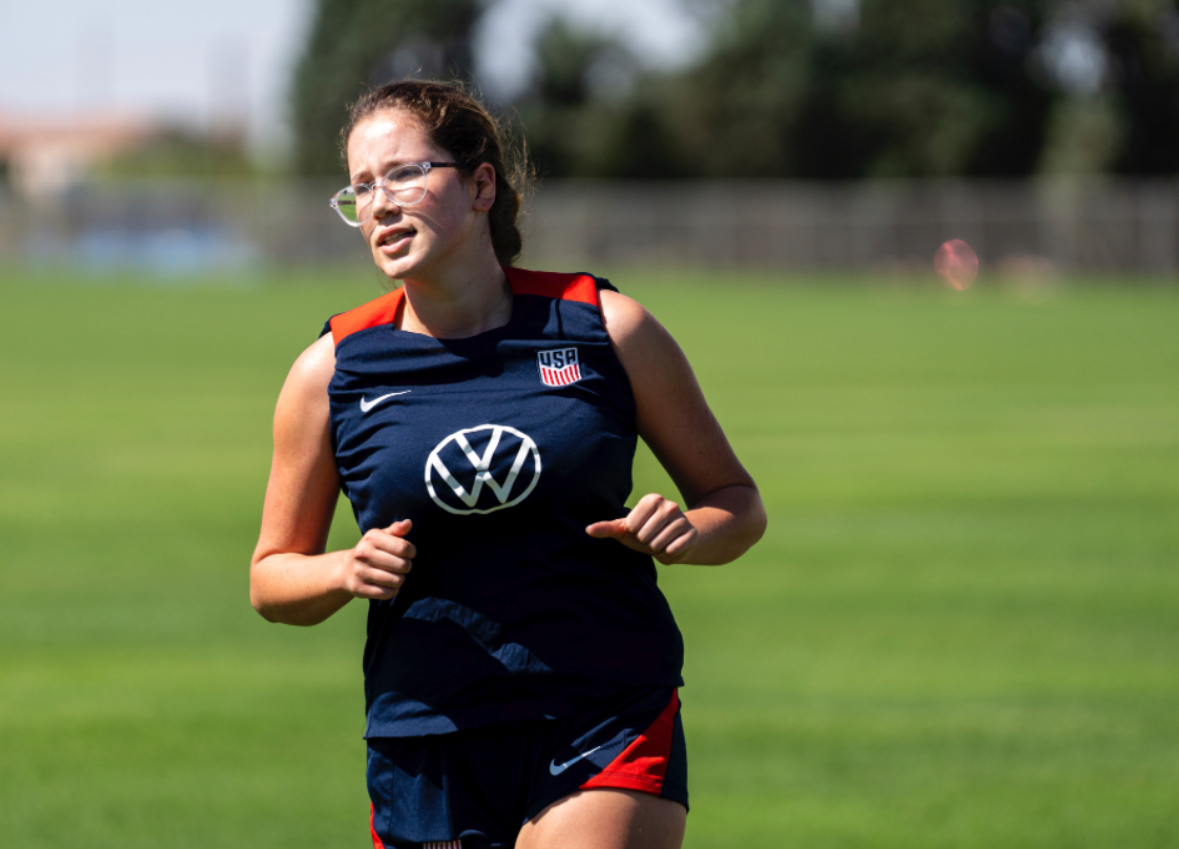
Breaking Barriers in Silence: Lenert’s Silent Pursuit of Gold
When Melia Lenert steps onto the soccer field, words aren't what connect her to her teammates--it's instinct and trust.
Every glance and gesture carries meaning.
Soon, those same nonverbal cues will travel far beyond Oskaloosa as Lenert prepares to represent Team USA at the 2025 Deaflympics in Japan.
A sophomore from Long Beach, California, majoring in Sociology with an Emphasis in Criminology, Lenert has always found freedom in the game.
Soccer became her language long before she fully understood the barriers she might face as a deaf athlete.
Now, she's turning that language into a global voice of perseverance.
"When I was younger, I was playing club soccer and the owner of the club, Mauricio, knew a girl playing on the Deaf National Team," Lenert said. "He helped schedule a meeting with the team and coaches. Coach Amy (Griffin) and Joy (Fawcett) came to watch me, and then I got to go to Coach Joy's house and meet most of the team and see all the medals they have won."
She continued, talking about her journey to the Deaflympics, "I completely forgot about the team until I committed here, and my dad said, 'Since you're going to be playing soccer in college, you should email the team and go to one of the camps.'"
That conversation reignited a connection she hadn't expected to return to so soon, a connection rooted not just in soccer, but in her identity.
Lenert was diagnosed as deaf at a young age due to a genetic condition, a moment that shaped not only her identity but also how she navigated the world.
Growing up, she learned early how to adapt, to communicate through expression, to observe closely, and to never let her hearing define her.
"Being deaf has changed my identity because I am surrounded by hearing people," she said. "But I can find that community online or with the Deaf team. It's a part of me that I am proud of."
Her pride in that identity intertwines naturally with her love for the game.
For Lenert, soccer became more than a sport, it became her constant.
"I just love soccer," Lenert said. "I have been playing it for my entire life; it's all I really know. Soccer is the only thing that gave me an outlet. It's a collective effort to win, but I can also focus on myself. It helps me stay grounded."
Her family helped nurture that passion. "My dad is always trying to get me to be the best player," she said. "He is always encouraging me to get out of my comfort zone, while my mom is always supporting me."
Nobody understands her experience better than her brother, Andrew.
Andrew is also playing in the Deaflympics for the US Men's National Deaf Team in Japan.
Talking about their journey together, "To play soccer with my brother at the Deaflympics is something I'll never forget. Sharing this journey with him makes it even more special, and it's an honor to compete for gold together."
That connection to the sport hasn't come without risk. Because she wears cochlear implants, physical contact on the field can be dangerous.
A stray elbow or header could dislodge or damage her devices, forcing her to play with extra awareness and care. Yet she's never let that risk hold her back.
"As I get older, I feel like it is still a barrier," she explained. "I can't always hear on the field, so I don't always get calls. I'm always aware, but it can lead to mistakes. Sometimes people need to remind the coach when he is yelling to me."
That awareness, both of her surroundings and of herself, has shaped how she approaches the game and life beyond it.
When Lenert joined William Penn University, she brought that same determination and quiet strength with her.
Moving from California to Iowa was a major adjustment, but her teammates quickly became an extended family.
"My teammates are the best people," she said. "I love them with my heart and soul. They support me so much, along with the coaches. They're okay with me missing over a month for games and training for the Deaflympics."
Her preparation for the international stage involves balancing classes, training sessions, and the emotions that come with representing her country.
"I am balancing so many things at once," she said. "Missing school can be really hard because it can affect my grades."
Still, she's focused on what lies ahead.
"It is a lot of pressure," Lenert said. "We (The U.S. Women's Deaf National Team) have never lost a game. It's honestly really impressive, and I'm glad I can be on a team like this. It means a lot to me that I can be on a team with the same disability as me. It's cool to be all together and play together."
"It is an honor to represent the nation and other deaf athletes and kids that are younger and don't feel like they fit in as much," she added. "I want to be an inspiration to all of the boys and girls who don't feel the same as other hearing people."
While Lenert's goals include making an impact at the Deaflympics, she also sees her journey as a chance to inspire others, especially young athletes who are deaf or hard of hearing.
"To be an inspiration for other deaf children," she said. "I honestly hope that I can help other people."
Her journey hasn't just been about learning to hear, it's been about learning who she is.
"The scars behind my ears from where they cut to implant are like a brand that I wear proudly," Lenert said. "In hindsight, my journey hasn't just been learning how to hear, it's been learning to straddle two worlds."
She added, "It's about recognizing that communication involves more than speech, and that identity is not singular. The day I heard for the first time through my cochlear implants wasn't only about sound; it was about possibilities, breaking barriers, and realizing who I am and who I could be."
As she prepares to wear the red, white, and blue, Melia Lenert isn't just chasing a dream; she's showing the world that the power of passion can be heard in more ways than one.
The U.S. Women's Deaf National Team holds a 37-0-1 all-time record, and Lenert hopes to help continue that legacy. Learn more about their upcoming games at ussoccer.com.